
Making The Connection Between Health and The Environment
Tuesday, October 14, 2008
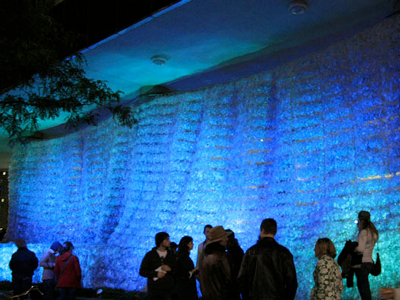
Waterfall, Toronto Nuit Blanche, 2008 by artist Katharine Harvey (posted in blogto.com)
by Marilyn Freedman
I want to share a recent article written by Dr. David Suzuki. It is an article that was written as part of his weekly Science Matters column, which I subscribe to. Dr. Suzuki’s approach to environmental issues, and to environmental activism, is a holistic one. Humans are part of the environment they create, and live in. We think of the environment on a global scale. My job, as a homeopath, is to bring it down to the individual. Here is just one example of how this connection between health and the environment works: As part of the Nuit Blanche Toronto 2008 there was an exhibit of a waterfall made from a giant “duvet” of commercial fishing nets and dumpster loads of recycled, clear plastic water bottles, draped from the Ontario Power Generation building at College and University. At night it was lit up, and evoked – a flowing waterfall. As an artist I marvel at how Harvey came up with the idea, and the location to install it. As an expression of art I think that it is really fantastic. Is Harvey is making the same statement as David Suzuki? We can be taken in by the convenience of carrying around water, by the convenience of recycling, and the seemingly inexpensive cost to us. It is deceiving to think that there is no repercussion to our health, to the environment, and to our pocket books. Clear plastics leach toxic chemicals which are carcinogenic. How many of you young parents are still using clear plastic baby bottles? Our oceans have islands of plastics that are being described as landfills, suffocating fish and foul. We are creating a society that will soon accept that the water we drink is a privilege, and not a right, and the bottle that costs a little over a dollar now will soon be a few dollars. Food for thought for the next time you go to buy a recyclable plastic water bottle.
Since I don’t know how long the article is kept for by the Suzuki foundation I am reprinting it here. Hopefully Dr. Suzuki won’t mind.
Dear Friend:
Here’s your weekly Science Matters column by David Suzuki with Faisal Moola.
Putting humans in their place
Andrew Weaver’s recently published book, Keeping Our Cool: Canada in a Warming World, is an urgent call to action that some of the folks running for the privilege of leading us into the future seem to be ignoring. Dr. Weaver, a world-class climatologist who is putting the University of Victoria on the global map, was one of the lead authors on papers put out by the UN Intergovernmental Panel on Climate Change. In that role, he shared with other panel members the Nobel Peace Prize last year.
online When it comes to
In the book, Dr. Weaver argues that if we are to stabilize atmospheric levels of carbon at a level that will not result in climate going haywire, we must begin massive reductions in greenhouse gas emissions now with a goal of totally eliminating our output of them. If we don’t, 80 per cent of all species could become extinct! That’s an astounding prediction, and if we think we’ll somehow survive such a catastrophic crisis, we should think again. When I first read about colonies of honeybees dying out, a bolt of fear went through me. Without pollinators, most flowering plants will not survive, and that would devastate the makeup of species on the planet.
We have become the dominant animal on the planet, and it has been an amazing story. But in puffing ourselves up with self importance, we have lost sight of how little we know about the way the world works and how utterly dependent we are on the services that nature performs for us, like removing carbon dioxide from the air and replacing it with oxygen – not a bad service for animals like us.
Eminent Harvard ecologist and ant expert E.O. Wilson once told me that if humans disappeared overnight, only a handful of organisms would also go extinct: creatures that live on our skin, in our armpits, and our groins and guts. The rest of nature would rebound, the planet would green up, and animals would increase in abundance. But if all the ants went extinct overnight, whole terrestrial ecosystems would collapse, and the makeup of animals and plants would change catastrophically. Kind of puts humans into perspective.
Today’s youth spend the least amount of time outdoors of any generation in history. And most of us live in cities surrounded mainly by other human beings and a few domesticated plants and animals and pests. So when we hear reports of vanishing glaciers and breaking ice sheets in Greenland and Antarctica, even endangered polar bears, it’s hard to relate. In British Columbia, northern forests have turned red because the mountain pine beetle, an insect the size of a grain of rice, is no longer kept in check because winters aren’t cold enough to kill them. Yet this $65 billion loss still seems to have little impact on our thinking as British Columbians vent outrage at Premier Gordon Campbell’s puny carbon tax.
I guess we think air is almost infinite, rising to the heavens. But astronaut Julie Payette described to me the experience of circling the planet in a space capsule: Every time the sun rose or set, which was every hour and a half, she saw a thin layer just above the Earth’s surface. That’s the atmosphere. As the late Carl Sagan pointed out, if the Earth were shrunk to the size of a basketball, the atmosphere we all depend on for our very survival would be thinner than a layer of varnish. That’s it, and everything our tailpipes, chimneys, and engines vent goes into that thin layer.
We apparently now put health as one of our top priorities in this election. Well, when we use air, water, and land as a garbage can, do we think we are somehow immune to the health consequences? We’ve got to see the world as it really is – a complex interaction of air, water, land, and living things, all interconnected and all interdependent. We are rampaging across the planet, treating it as our plaything, as our source of raw materials, as our dumping ground for our waste and emissions. And then we whine like mad when reminded that we have to change and we have to pay for what we do. Why haven’t we heard more about this perspective in the current election campaign?
Take David Suzuki’s Nature Challenge and learn more at www.davidsuzuki.org.